
Have you ever been in a situation where time slowed down or even stood still? Where every action you commit to is perfect and effortless. When you lose your sense of self and become at one with the activity you are doing. If you have you will certainly remember it vividly.
Most people have achieved these moments fleetingly on a daily basis. Some people have a life full of absorption and fulfilment and seem to flow from one challenge to the next at consummate ease. Others however seem to be always overwhelmed with the stresses of life. This difference is what engaged Bulgarian Psychologist Mihayli Csikszentmihalyi to study the experience of Flow. Csikzentmihayli interviewed thousands of people from every walk of life across every continent in the world. His goal was to find the characteristics of the Flow experience and try to measure why certain people seemed to be in flow more than others. Interestingly 20% of people enter flow states on a regular basis but 15% never do.
His findings give us a fantastic insight into happiness and how people perform at their best. A remarkable finding of his has been in relation to challenge and stress. It is often the case that stress and challenge in our lives is interpreted as a negative emotion and that the associated anxiety can become debilitating. Furthermore, that the best moments in our lives are passive and relaxing times with no worry or concern.
Csikszentmihalyi discovered that this is certainly not the case, "The best moments in our lives are not the passive, receptive, relaxing times…" in fact he identified that in order to experience flow we need to be challenged and stressed to the point where we make flow happen and become at one with the process, “The best moments usually occur when a person’s body or mind is stretched to its limits in a voluntary effort to accomplish something difficult and worthwhile. Optimal experience is thus something we make happen.”
The key question then is, how do we make it happen?
There are key prerequisites of the flow experience:
The sense of time becomes distorted
There is a balance between challenge and skill
There is clear goals
There is no worry of failure
Distractions are excluded from consciousness
The activity is an end in itself
Self-Consciousness disappears
Action and Awareness are merged
Consequently the ‘Flow’ that is often experienced by athletes can certainly be experienced by executives, leaders and indeed every human being.
In all flow state experience their certainly seems to be a level of stress involved. Psychologists have investigated for centuries the human response to stress. Traditionally they have found two main responses to stress, Fight or Flight. These responses were necessary for our human survival from the beginning of mankind. Originally as hunter gatherers we lived in savannahs and jungles with the constant threat of enemy attack. Lions and other beasts roamed the plains. For humans to survive we needed to become stressed when we saw a potentially threating situation, this flooded our bodies with the necessary cortisol and adrenaline to fight or flight like our lives depended on it. Essentially our lives did depend on it! Without these responses we may not be here today!
In studies on Flow states however they are certainly not experienced by fighting issues, running away from them or freezing to a halt. People seemed to have a completely different response to stress in a Flow state, essentially a positive one.
Could it be that the stress response is an antecedent to flow? That the mind essentially needs to be strained in order to ‘flow’ and think at its best? That the thought patterns emerging from Flow are indeed a consequence of a demanding situation?
After further investigation I discovered that there is a fourth, Submission (Marks, 1987) and a fifth response to stress that the latest science has only began to investigate, ‘Flow’ (Peifer et al., 2014).! Stress is necessary to achieve flow. The optimal state required to perform.
To echo Csikzentmihayli (1990),
“The best moments usually occur when a person’s body or mind is stretched to its limits in a voluntary effort to accomplish something difficult and worthwhile. Optimal experience is thus something we make happen.” (Csikszentmihalyi, 1990, p.3)
This finding is a moment of enlightenment for many. Essentially the very state that humans are striving to create is ‘flow’. Inherent in us achieving this joyous and focused state is stress!
A recent study in the journal of experimental social psychology concluded that moderate levels of stress were specifically associated with the flow experience in an inverted U basis (Peifer et al., 2014). Essentially a person to be at their best requires challenge and moderate levels of stress to reach creative solutions in task orientated situations (see figure 1).
From a philosophical standpoint, stress and suffering is an inevitability of life. However our interpretation of stress and suffering dictates our wellbeing on a daily basis. The latest research shows that stress and suffering is not as detrimental as it may at first seem, in fact it is a necessary antecedent to many optimal experiences like Flow.
The key is to find the optimal level of challenge. This is how we grow. The next time you’re feeling overwhelmed or overstressed remember that every river has its source. Once the source is stopped the river is HALTed. A great practical way to find the source of overstress is to remember the acronym H.A.L.T. Overstress comes from many sources but it often occurs from Hunger, Anger, Loneliness or Tiredness. When you can identify the source then it’s time to do something about it. After all Flow is something we can Make Happen!
Modern society often reflects excess demands and divided attention that causes overstress. The information highway is at our fingertips. Our work demands are increasing. We strive to meet social standards and expectations magnified by social media. Our families require increasing finance and care. In the midst of it all we must remember to H.A.L.T and find an activity or task that we can become totally absorbed in and truly enjoy the presence of life. What can you do today to achieve more flow experiences in the future? How can you cherish the beautiful moments of life? Make it Happen!
 Inspiring Excellence
 Manager
 Sep 09, 2025
Life is not meant to be easy. Or is it?
“Hard choices, easy life. Easy choices, hard life.”
It’s ok, not to be ok – but is it ok to remain in that frame without action? When we feel down and at a low point our choices are:
We choose to remain in that low ebb, negative frame
We choose to do something to make ourselves feel better
The primary reasons stopping us from being our best is.
The lack of optimism we have in ourselves and from others
Our emotional intelligence — specifically, our ability to understand and manage our emotions, what psychologists call emotional regulation
Unless we have a basic frame of optimism in our lives we will never be content or happy. Many of us chase the rabbit wheel of happiness, running for it every day but never going anywhere.
I will be happy when .... becomes the mantra. I will be happy when I find true love, I will be happy when I get a new job. I will be happy when my work day is finished. I will be happy when the current crisis is over. Then what?
“Happiness is not a destination it’s a state of being.”
And thankfully we can put ourselves in that state more frequently by learning optimism.
What is optimism? let us first nail down what it is not, optimism is not sticking your head in the sand and being oblivious to the challenges of life, or pretending that there are no challenges when their quite clearly are.
Optimistic people actually identify problems quicker than others, once they identify the problem then they ACT. They find solutions quickly and move on. If they’re not feeling ok they ask themselves why? If they don’t have the answers they ask others why? Then they act to identify the solution.
“Man does not simply exist but always decides what his existence will be, what he will become the next moment. By the same token, every human being has the freedom to change at any instant.”
Viktor Frankl
Our power is in our action, approaching the problem and identifying a solution. The obstacle - to whatever it is that is making us feel less than our best, below our norm, ‘not ok’, is the way.
“He says the best way out is always through, And I agree to that, or in so far as I can see no way out but through.”
Robert Frost
Sadly, many of us have been living a lie. We have lived in the safety net of life with fear of expressing who we truly are. The fear that our truthful self-expression - may lead to judgment, ridicule and even laughter. If were ‘not ok’, well that’s ‘ok’ we will move through another day in a societal fog. Where the day is run by emails, by social media, by capitalism, by others and by our own inner thoughts of worthlessness and pessimism.
Safety is overrated. There is another way. The power to create that other way lies dormant within many. Waiting for the spark that ignites the flame to break free and be who you are. To be, ‘happy in ourselves’ despite what is happening around us. To be, ‘ok’.
“Our deepest fear is not that we are weak. Our deepest fear is that we are powerful beyond measure. It is our light, not our darkness that most frightens us. We ask ourselves, who am I to be brilliant, gorgeous, talented, fabulous? Actually, who are you not to be? You are a child of God. Your playing small does not serve the world ... As we are liberated from our own fear, our presence automatically liberates others.”
Nelson Mandela
It is our light not our darkness that most frightens us . . .
If we are willing to do the hard work on the interior of our lives now, there are absolutely no limits to our growth and our potential.
But what if I’m just not optimistic? Thankfully it can be learned. And its quite simple to understand. Psychology now shows the hard science behind optimism and proves unequivocally its proven benefits. Optimism effects outcomes in relationships, optimists have a greater quality of life, greater emotional wellbeing and are happier, they stay on in high stress jobs more than their less optimistic peers, they sell more, and they live longer! Optimistic athletes have also been proven to perform better in high stress situations.
If we want to see the light, its time we stepped up and into the actions that will take us there. It’s time we faced down our fears. It’ time we liberated ourselves and others from the shackles of darkness.
Well, ‘How’?
Part 1
Personalization: How personal do we take the setbacks or the challenges in our lives. Do we interpret them as something personal, just part of who we are or was the setback or challenge more external.
Optimists can identify the factors outside themselves that have caused a setback or a challenge. They understand that cause of the setback can be attributed to other factors and lifes challenges are not a representation of who they are.
Say you lose a tennis match. A pessimistic player will interpret the cause as personal (‘I failed’). This contrasts with an optimist who allows for non-personal factors (‘grass just isn’t my surface’).
Part 2
Permanence: How permanent do we believe our challenges are? If I am ‘not ok’ is that going to be forever? Or just for a period of time? The difference between perceiving an event as permanent or temporary can be life altering.
Pessimists interpret setbacks as permanent (‘I’ll never succeed at this level’). In contrast, an optimist sees the setback as only temporary (‘I didn’t prepare well this time/I had a cold’).
Part 3
Pervasiveness: Do we see our setbacks as all encompassing? Representing all of our life or maybe we see them as confined to a specific area.
Pessimists see setbacks as all-pervasive (‘nothing works out for me’). In contrast, the optimist sees the setback as narrowly contained or confined to one area of life (‘I still have a life outside of playing tennis’).
Optimism is external, unstable and specific. Our challenges in life do not define us, our emotions do not define us, our REACTIONS do. If we are not ok it doesn’t mean we will have this feeling forever. It does not mean it represents everything in our lives. The human body and mind has the power and resources to bounce back from almost anything. There is always another way. In fact that feeling, that emotion might be the very thing we needed to regain control over our lives, commit to action, approach our challenges and go through them.
“Let me tell you something you already know. The world ain't all sunshine and rainbows. It's a very mean and nasty place and I don't care how tough you are it will beat you to your knees and keep you there permanently if you let it. You, me, or nobody is gonna hit as hard as life. But it ain't about how hard ya hit. It's about how hard you can get hit and keep moving forward. How much you can take and keep moving forward. That's how winning is done!”
Sylvester Stallone
Optimism is not a magic bullet, it’s a belief system.
Optimists do not think the world is all sunshine and rainbows, optimists are better than pessimists at actually identifying problems. Therefore they can effect the change and/or outcome of a situation.
They see situations as challenges and not a threat.
They identify whats in their control to influence or leverage. The optimist says this piece of this problem I can do something about it whilst the pessimist focuses on the aspects of the problem she can do nothing about.
It's not just control that the optimist focuses on. The optimist is more likely to accept the aspects of the situation that he or she can't control. So rather than focusing on parts of the situation that I can't change anyway, the optimist focuses on the parts that he or she can change, and accepts the parts that he or she can't. Think about what that means for our energy. If our energy is going toward changing what's changeable.
Optimists approach the problem whilst pessimists withdraw. Optimists are more likely to seek more information. The optimist is more likely to ask for help. Optimists even use humor as a coping strategy.
If you're identifying problems, seeing challenge not threats, focusing on what you can control, taking purposeful action, and not sweating the stuff you can't do anything about. If you're asking for help, and making plans, and taking action, and using humor, if you think about that constellation of ingredients of an optimist, you can see how those thoughts and behaviors, lead to the life changes we've talked about.
Simply, optimism leads to really important behavioral differences, and those behavioral differences affect our health, our relationships and our mortality!
Here are some questions to get us thinking:
Who are you really?
What are your values?
What is important now?
How are you really feeling about your life right now?
Do you approach or withdraw from problems?
Do you fear being ‘powerful beyond measure’?
Are you afraid of the light?
Do you identify factors outside yourself to explain setbacks and challenges?
Do you see setbacks as temporary?
Do you see setbacks as an isolated area of your life?
Do you see the solution?
Do you see a better way?
Are you getting the most out of your life?
What will you do now?
If you want to continue to take your thinking to the next level,
Inspiring Excellence delivers bespoke corporate training programs on Navigating Uncertainty. The programs are based on positive psychology and the resilience required to take you and your organization to the next level. Programs are all based on the revolutionary work of the ‘father of modern psychology’, Professor Martin Seligman.
These events equip employees with a set of practical skills that can be applied in everyday life to strengthen their ability to overcome adversity, challenges, manage stress, and thrive in their personal and professional life.
Decades of empirical studies indicate that positive psychology:
Increases well-being and optimism
Reduces and prevents depression, anxiety, and conduct problems
Improves physical health
Improves work productivity
Decreases absenteeism
For more information check out www.inspiringexcellence.ie , contact perform@inspiringexcellence.ie or learn your own positive character strengths like 5 million others at http://www.viacharacter.org/www/Character-Strengths-Survey
“We are not what happens to us, we are what we choose to become.”
Inspiring Excellence
Manager
Sep 09, 2025
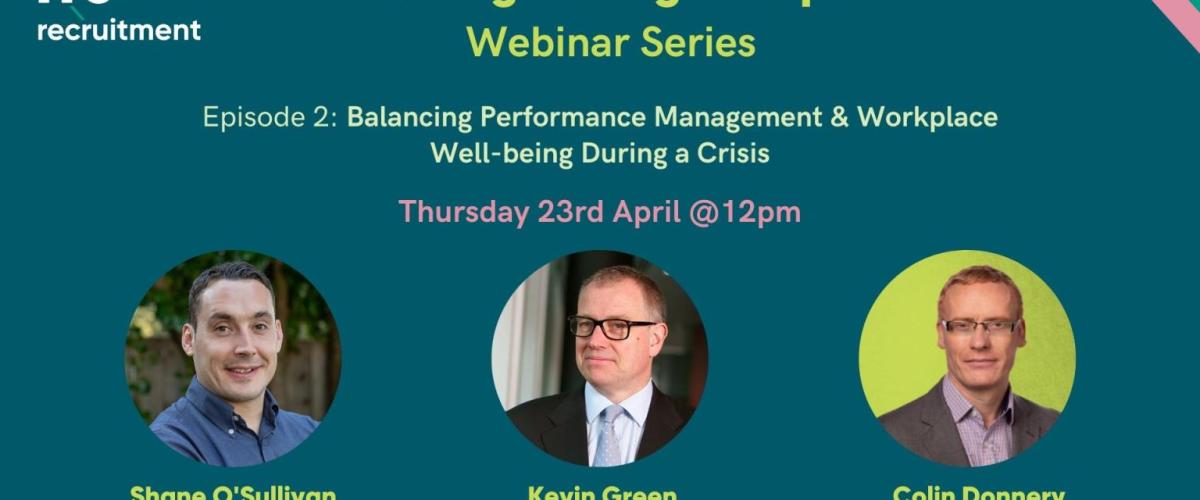
On the 'Leading Through People' webinar Shane teamed up with the UK and Ireland's leading recruitment consultants, Kevin Green and Colin Donnerry to share fantastic insights on managing performance and wellbeing. Some of the key discussion points included the importance of stress for high performance, communicating not only what’s changing but also, what is staying the same, and the necessity of company values. Watch it back here
Inspiring Excellence
Manager
Sep 09, 2025

“A leader is a dealer in hope”
Napoleon Bonaparte
During his legacy Alex Ferguson has been arguably the most successful manager in 21st century sport. Few leaders in any field have proven to be as persistently successful as Ferguson has been at Manchester United. He transformed the club from perennial underachievers living in the shadow of Matt Busby’s famous 1968 team into the most remarkably consistent football team that was ever established on British soil. Here are 8 principles we can all apply to our leadership, teams and organisations to thrive through these most challenging of times.
Identify the Current Reality
Ferguson’s rise to prominence and the evolution that he master-minded at Old Trafford was not without difficulty. His birth into leadership at Manchester United was severely problematic at first, clearing up the mess he discovered and resurrecting the football club to all their former glories. By star player Mark Hughes’s admission Ferguson had reason to worry, “the majority of the senior first team squad were very upset and angry” at his predecessor Ron Atkinson’s dismissal.
Ferguson’s initial nervousness was clear,
“No question at all, I was nervous. . . . I didn’t know anything about this club, really. I did not have a clue what the team was going to be. Didn’t even know the make-up of the side that got Ron Atkinson the sack 48 hours earlier”.
Ferguson’s team for his first game showed no great change to Atkinson’s line up’s. However, only one of the 12 players used that day survived Ferguson’s surgery over the next four years. The conflict and rebellion that followed ultimately revamped that original team into an extraordinary outfit destined for success.
Set Higher Standards and Hold Everyone Accountable
Almost immediately Ferguson implemented group principles that formed the foundation for the development of the team over the late eighties and early nineties. Ferguson introduced radical new training methods where the emphasis was placed on mental toughness and discipline. He insisted that no team should ever be fitter than united.
The playing squad was informed to arrive to training at 9.30 a.m. rather than 10.30 a.m. to ensure players would have to sit through the morning traffic like every other employee at the club. Day’s off were suspended. Players had to look respectable, clean shaven. The squad were supplied with new blazers that had to be worn on match day to create a unique identity. A strict rota was initiated for players to entertain corporate guests at home games. Players were told to run, not walk, off the pitch, and even steaks were banned to incorporate lighter meals on match days. These were all instances of the authoritarian approach that Ferguson used in the early years of his leadership to lay the foundation for future success.
Predictably these new principles were met with some anguish by certain players. Discipline and the high standard Ferguson set for the team became a problem for certain players who were used to the leisurely pace of Ron Atkinson’s regime. Social loafers were no longer accommodated. Inevitably the conflict that ensued led to the termination of many players careers at Old Trafford. Star players Paul McGrath and Norman Whiteside were known to be at the heart of a drinking culture that had a remarkable resemblance to the Steiner Effect (a groups reduced productivity due to faulty processes).
Ferguson eventually released both players during the storming stage of his reign at Old Trafford. He later admitted that he should have sold these players quicker as the delay meant it took much longer to rebuild the team. Ultimately, he believed eradicating these players was an important matter of principle in shedding United’s image as an organisation more interested in socialising than winning.
Provide a Compelling Vision of the Future and get Everyone on Board
In these early years Ferguson immersed himself in club histories and personally got to know every member of the 172 staff that was working at Manchester United. His objective was to understand what made the organisation tick and primarily to give each individual responsibility in their roles in establishing the club as a major force in football.
Ferguson’s will to succeed was almost pathological. In the summer of 1988 he declared,
“I am not kidding. This isn’t just a job to me. It’s a mission. I am deadly serious about it – some people would reckon too serious . . . We will get there. Believe me. And when it happens life will change for Liverpool and everybody else – dramatically”.
Although not apparent at the time, Ferguson was a visionary leader. He empowered every individual at the club from the laundry ladies to the chief scout with his vision of future success.
The culmination of Ferguson’s initial work came to the fore during the norming stage of the team’s development circa 1990/1991 which brought the F.A. Cup and European Cup Winners Cup back to Old Trafford. In the penultimate stage of the latter competition Ferguson developed a togetherness that instigated the beginnings of group cohesion that would eventually bring them league success in 1993.
In preparation for the final Ferguson arranged for the team to take over an entire hotel on the outskirts of Rotterdam in Holland. He ensured that a large lounge was transformed into a games room where pool tables, darts, quiz games and a large TV screen were brought. Ferguson knew the benefits of social connection in organisational development shared by leading organisational psychologists, “being in close contact and having the opportunity for interaction hastens group development”.
Rebuild from the Foundations
It was clear to a passionate footballing nation that Alex Ferguson was leading Manchester United to the forefront of domestic football. However, only an astute footballing critic with a trained eye could identify with the revolution that was implemented behind the scenes at Old Trafford. Ferguson always did have a love for the development of youth which he initially emphasised with success at St. Mirren and Aberdeen in his native Scotland. But it was at Manchester United where the leadership style he adopted for youth development had a lasting effect on world football.
Ferguson himself declared, “I have always considered that the player you produce is better than the player you buy”. As part of the strategic planning process, he obtained maps of the Manchester and Greater Manchester area and on them he delegated certain scouts to be responsible for certain areas. He tackled a deficiency in only five working scouts in the club and declared his priorities to each one, ‘I am not interested in the best boy in your street’ he told them, ‘I want the best boy in your area’. Significantly he appointed 1968 European Cup hero, Brian Kidd as the head of the main school of excellence. Ferguson would regularly watch youth games. Youth coach Eric Harrison later acknowledged that without Ferguson’s involvement Manchester United ‘would definitely not have signed all our superb youngsters’.
Protect your most Precious Talent
Ferguson’s transactional leadership style was exemplified in his dealings with a young welsh winger called Ryan Giggs whose longevity as a top class footballer may never be surpassed at Manchester United. From the moment Giggs set foot on the Cliff training ground and his talent became obvious, Ferguson, “protected Giggs like the treasure he was” and was a frequent visitor to the family home.
The United manager infuriated journalists by refusing all requests to interview the player, “I bolted the Old Trafford door and made certain Ryan was safe inside”. He even prevented Giggs from signing a boot deal worth £250,000 and other youth players were informed to expect similar restrictions!
Ferguson was both a transactional leader who focused on the physiological, safety and belonging needs of the youth; and a transformational leader who provided vision, built trust and ultimately inspired young players at United to prosper. Powerful leadership traits that inspire organisational development and growth in times of uncertainty and challenge.
The seeds Ferguson sowed in youth development culminated in arguably the greatest youth team ever assembled in any club or any era. Of the fourteen players who participated in winning the FA Youth Cup in 1992 only three never appeared on the United first team. Eight would go on to represent their country at international level including Gary Neville, David Beckham, Nicky Butt, Paul Scholes, Ryan Giggs, Robbie Savage and Keith Gillespie. Perhaps the greatest attribute Ferguson had as a manager was the leadership style which nurtured these talented players in reaching their true potential.
Meanwhile the first team’s development was progressing rapidly with the signing of a certain French catalyst, Eric Cantona in November, 1992. With the help of Cantona’s inspiration United began performing to a level that Ferguson had strived for during the previous six years he was manager of the club. Members were now directing all their energies collectively towards winning the coveted title that had bewildered the club for 26 years.
Delegate and Trust Others
Faulty processes had been weeded out and Ferguson began to trust individuals to get the job done. He began his pre match talk at 1.30-2.00 p.m. and then he let players get on with it; “I think if I am continually around them before the game, talking to them or reminding them of this or that, I am suggesting a lack of trust in them . . . . You must show confidence that they can handle the job”.
The delegating style Ferguson used to such an effect with the youth team was now being echoed with the first team. His management methods were evolving.
“For years I did the coaching, the organising of the training programmes, the pre-season schedules, the warmups, the lot. But now I realised that, as my sense of the job’s priorities developed, the art of observation had to play a bigger part”.
Consequently, Ferguson let Brian Kidd and other senior figures at Old Trafford to take on more responsibility in preparations.
This evolution culminated in collecting the league title in 1993. A symbolic day for Ferguson,
“The day I truly became manager of Manchester United . . . there was a sudden, overwhelming realisation that now I was master of my own destiny”.
Ferguson declared that he had learned more in those six years about leadership, than he did in the previous forty-five.
This was only the beginning. The team Ferguson built at Old Trafford reached its pinnacle the following year whilst clinching a remarkable league and cup double. Breaking numerous records in the process including, a record amount of league points and new club records for games won (41), successive games undefeated (34), consecutive away wins (7) and undefeated home games (36). Eric Cantona collected the PFA Player of the year award and Alex Ferguson was Manager of the Year for the second season running. People were now starting to compare Ferguson to his illustrious predecessor Matt Busby.
In the eighteen months after the double, that great team was slowly broken up. Like many great teams, there evolution was cyclical and eventually terminated following the unique achievements of 1994. Many instances during the following season led pundits to believe that Manchester united would never produce such a team again. Faulty processes started to creep back into the team.
Eliminate Bad Apples
Indiscipline was symbolised by Eric Cantona’s infamous Kung Fu kick on a Crystal Palace supporter in January, Andrei Kanchelskis’s transfer request which was overlaid with frightening aspects of corruption and threats of violence, and Paul Ince’s refusal to carry out the managers instructions during games. As Ferguson himself explained,
“I felt like the Dutch boy trying to plug holes in the dyke with my fingers”.
Luckily for United, Ferguson’s experience had thought him how to plug holes in the dyke. He acknowledged the debilitating effects that ‘the law of the bad apple’ can have on any team (one bad apple can spoil the cart, one good egg doesn’t make a dozen).
Ferguson knew, what Organisational Psychologist Adam Grant proved many years later - The cost of selfish takers far outweigh the benefits of generous givers. Consequently, despite the interests of the board and the fans, Ferguson immediately eliminated these ‘bad apples’ from playing any part in the future of Manchester United.
Interestingly Ferguson exemplified the multidimensional model of leadership when he took exception to Cantona’s case, even though it was the most dramatic incidence of indiscipline ever seen at the club. Whilst Cantona was contemplating moving to Inter Milan following his frustration with the English F.A., Ferguson flew to Paris to negotiate a deal that would keep Cantona at Old Trafford for the following four years.
Ultimately Ferguson had the foresight to realise that despite his indiscipline, Cantona would be the perfect catalyst to inspire the group of youngsters that would now become household names at Old Trafford for the next decade.
Never Stop Evolving
What happened next was the realisation of a dream that Ferguson had been waiting to implement for a number of years,
“I have seven or eight kids waiting patiently for the opportunity, young footballers on the threshold of the big time . . . I don’t think it is possible to manoeuvre eleven through the ranks together, but in slow stages, I believe it is the dream that can be realised”.
With the introduction of the Neville brothers, Beckham, Butt, Scholes, Giggs and the retention of their charismatic leader Cantona, Manchester United began a period of dominance in the domestic game that has aptly been described as a dynasty. In the four years that followed 1995, Manchester United had surpassed all previous expectations and won four Premier League Championships, two F.A. Cup’s, and emulated the wonderful success of Matt Busby’s 1968 team in winning the Champions League in 1999.
In the 14 years after that famous day in the Nou Camp, Ferguson achieved 8 more Premier League Championships and a second Champions League Success in 2008. He nurtured the worlds greatest player Cristiano Ronaldo, just like he had Ryan Giggs a decade previous. The principles, structures, team development and leadership style that Ferguson implemented since 1986 put him in his rightful place in history as one of the greatest leaders that has ever graced any field, in any era.
Difficulties have been constant at Old Trafford since. The passing of time since his departure has illuminated his influence and the importance of succession planning as organisations and teams evolve.
Inspiring Excellence facilitates team coaching events that inspire and transform organisations. We create bespoke solutions that match specific client needs. From remote off-site days to facilitating focused leadership team events on navigating uncertainty.
The programs are based on developing your leaders and teams to a higher performance with the resilience required to take your organization to the next level in a rapidly changing environment. Programs are all delivered remotely using scientifically proven methods, psychometric assessments by accredited leadership coaches with global experience.
These events equip teams with a set of practical skills that can be applied in everyday life and work to strengthen their ability to overcome adversity, challenges, manage stress, and thrive in their personal and professional life.
For more information check out www.inspiringexcellence.ie, contact perform@inspiringexcellence.ie or learn what our most recent clients say about what we do https://www.inspiringexcellence.ie/tesimonials
Theory Buster
Social Loafers: social loafing is the inclination to reduce effort when working towards a common goal with others. Researchers have proved significantly that individuals who thought they can get ‘lost in the crowd’ did not try as hard as they would if they thought they could be identified as individuals. Minimizing social loafing in team sports is obviously crucial, making individuals accountable for a personal performance standard is one way of eliminating the detrimental effects social loafing can have on team performance.
The Steiner Effect: Psychologist Ivan Steiner developed a model which showed that a group’s actual productivity is the result of its potential productivity minus losses due to faulty group processes. The model suggests that the coaches role is to increase available resources ( through training, instruction etc) while also reducing process losses (by enhancing cohesion and the individuals contributions to the team.)
Storming: From the linear perspective of team development which assumes that groups move progressively through four crucial stages. The second stage of team formation, storming is characterized by resistance to the leader, resistance to control by the group and interpersonal conflict.
Roles: A role consists of the set of behaviours required or expected of the person occupying a certain position in a group
Norming: From the linear perspective of team development which assumes that groups move progressively through four crucial stages. The third stage norming occurs where hostility is replaced by solidarity and cooperation. Conflicts are resolved and a sense of unity forms.
Group Cohesion: is exemplified when a teams members are united in a common purpose. Cohesion is often a holy grail for coaches and managers, it is difficult to find but almost magical in its effects, transforming an aggregation of individuals into a collective unit. Many teams who possess outstanding individual athletes often underachieve, while teams of average players exceed all expectations. The difference usually is that the latter team is cohesive, each individual selflessly working towards the aims of the team rather than their own personal ambitions.
Transactional Leadership: is more closely associated with management which involves a leader - worker exchange relationship in which punishment is withheld or rewards are provided , in return for performance.
Transformational Leadership: by contrast influences others by their ability to inspire, empower and stimulate others to achieve beyond expectations towards the achievement of goals.
Catalyst: A catalyst is a player who makes things happen. A catalyst has great vision and can inspire a team to take their performance to another level.
Cyclical: The life cycle model of teams have in common the assumption that groups develop similar to individuals - experiencing birth, growth and death.
The law of the bad apple: This is often exemplified by players with bad attitudes. Players with personal ego’s. Players who always put their own needs and wants ahead of the groups.
Multidimensional model of leadership: explains that leadership effectiveness in sport will vary depending on the characteristics of the athletes and constraints of the situation.
Dynasty: A sports dynasty is a team that dominates their sport or league for multiple seasons or years.
Inspiring Excellence
Manager
Sep 09, 2025
Stay up to date with the latest news, announcements, and articles.